Beneath the Surface: How Default Routes Establish Primary Connections in Networked Environments
Default routes serve as the foundational mechanism that directs traffic when no more specific entry exists in a routing table, allowing devices across local and wide area networks to reach destinations beyond their immediate subnets. Network administrators configure these routes, often represented as 0.0.0.0/0 in IPv4 or ::/0 in IPv6, to point toward a gateway that handles all unmatched packets. This setup ensures connectivity in environments where complete route knowledge remains impractical due to scale and complexity.
Mechanics of Default Route Operation
Routers examine incoming packets against entries in their forwarding tables, matching the longest prefix first before falling back to the default route when necessary. The process begins at the host level where operating systems install a default gateway during DHCP assignment, then extends through enterprise routers that aggregate traffic toward upstream providers. Data from network monitoring tools shows that default routes account for the majority of inter-domain traffic flows in large-scale deployments, because specific routes cover only internal prefixes while external destinations rely on this catch-all entry.
Implementation Across Network Layers
In home and small office setups, consumer routers receive default route information from internet service providers via protocols such as PPPoE or DHCP, which then propagates to connected devices. Enterprise environments expand on this model by using dynamic routing protocols like OSPF and EIGRP to distribute default routes from border routers inward, reducing configuration overhead on internal devices. Observers note that this hierarchical approach prevents routing table bloat, since core routers maintain detailed tables while edge devices depend on summarized defaults.
Wireless access points and software-defined networking controllers further automate default route assignment, updating gateways in response to link failures or policy changes. Studies from academic research groups indicate that proper default route tuning improves convergence times during outages, because traffic shifts automatically to alternate paths without manual intervention at every node.
Role in Establishing Primary Connections
Primary connections form when default routes align with the main uplink to external networks, whether that involves a corporate internet link or a data center peering point. Network operators verify these routes through commands that display the routing table, confirming that the gateway address matches the provider's edge device. In August 2026 network infrastructure reports highlighted continued reliance on stable default route configurations amid growing IPv6 adoption, where dual-stack environments maintain separate defaults for each protocol family to avoid reachability gaps.
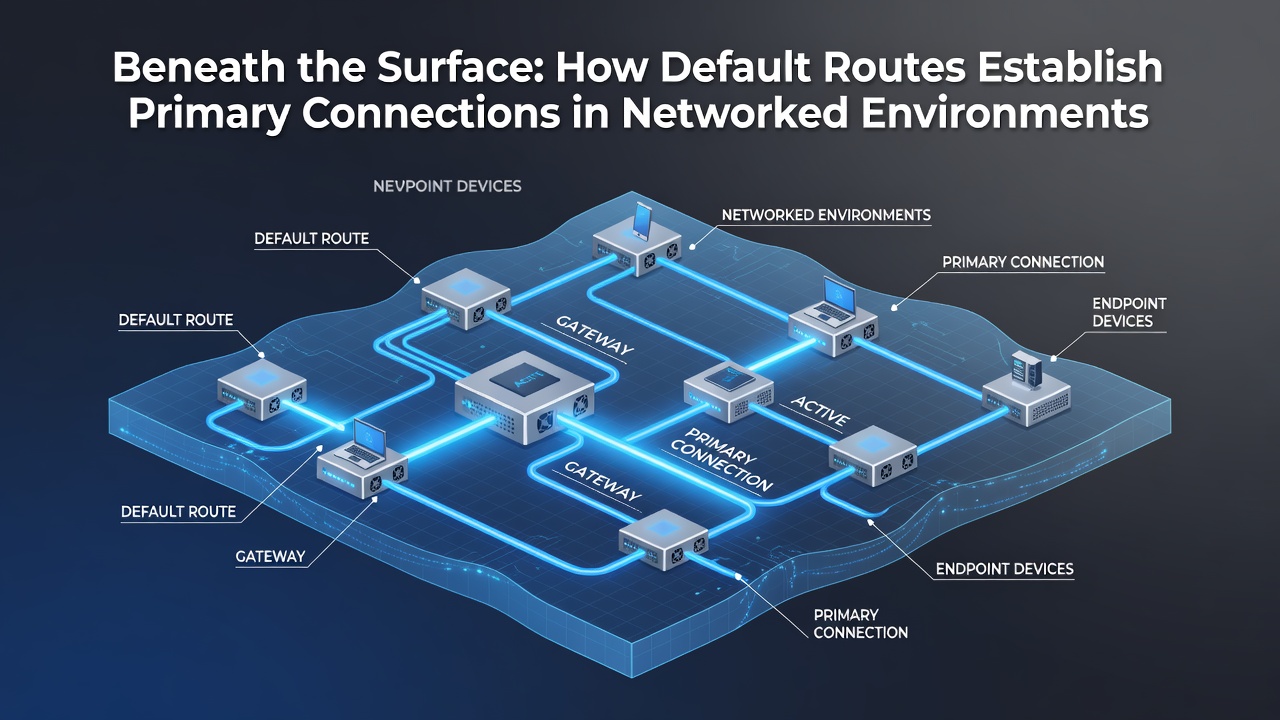
Packet forwarding follows a predictable sequence once the default route activates: the router rewrites the layer-two header with the gateway's MAC address, then transmits the frame toward the next hop. This mechanism underpins everything from simple web requests to complex cloud service interactions, since most application traffic targets addresses outside the local segment. Researchers at technical institutions have documented how misconfigured defaults lead to blackholing, where packets disappear without trace because the assumed gateway cannot forward them.
Security and Redundancy Considerations
Firewalls positioned at default route gateways inspect traffic that would otherwise traverse unchecked, applying rules that protect internal assets. Redundant default routes, implemented through floating static entries or protocol metrics, provide failover when primary links degrade. Government agencies in Canada and Australia publish guidelines on validating these routes to mitigate risks from route injection attacks that could divert traffic through unauthorized paths.
Traffic engineering leverages default route adjustments to balance loads across multiple providers, directing portions of outbound flows based on cost or performance metrics. Industry reports from organizations such as IEEE detail case studies where default route policies reduced latency for international connections by selecting optimal exit points. Those managing large networks often combine these routes with prefix lists to block invalid destinations at the source.
Protocol Interactions and Evolution
Border Gateway Protocol sessions between autonomous systems exchange default route advertisements under specific conditions, allowing smaller networks to inherit reachability from larger transit providers. Internal protocols inject defaults at distribution layers to simplify configuration for access devices. Evidence from protocol analysis tools reveals that route maps and distribute lists refine default route propagation, preventing loops while maintaining reachability.
Modern implementations incorporate route tagging and administrative distances to prioritize learned defaults over static ones when both exist. This layered decision process ensures that changes in upstream topology propagate correctly without disrupting local connectivity. Data indicates steady growth in environments using anycast defaults for content delivery networks, where multiple gateways share the same address to localize traffic.
Conclusion
Default routes remain central to networked connectivity by providing the essential fallback that enables communication beyond known prefixes. Their configuration influences everything from basic internet access to sophisticated multi-homed architectures, while ongoing protocol refinements continue to enhance reliability and security. Network professionals monitor and adjust these routes as topologies evolve, maintaining the primary connections that support daily operations across diverse environments.